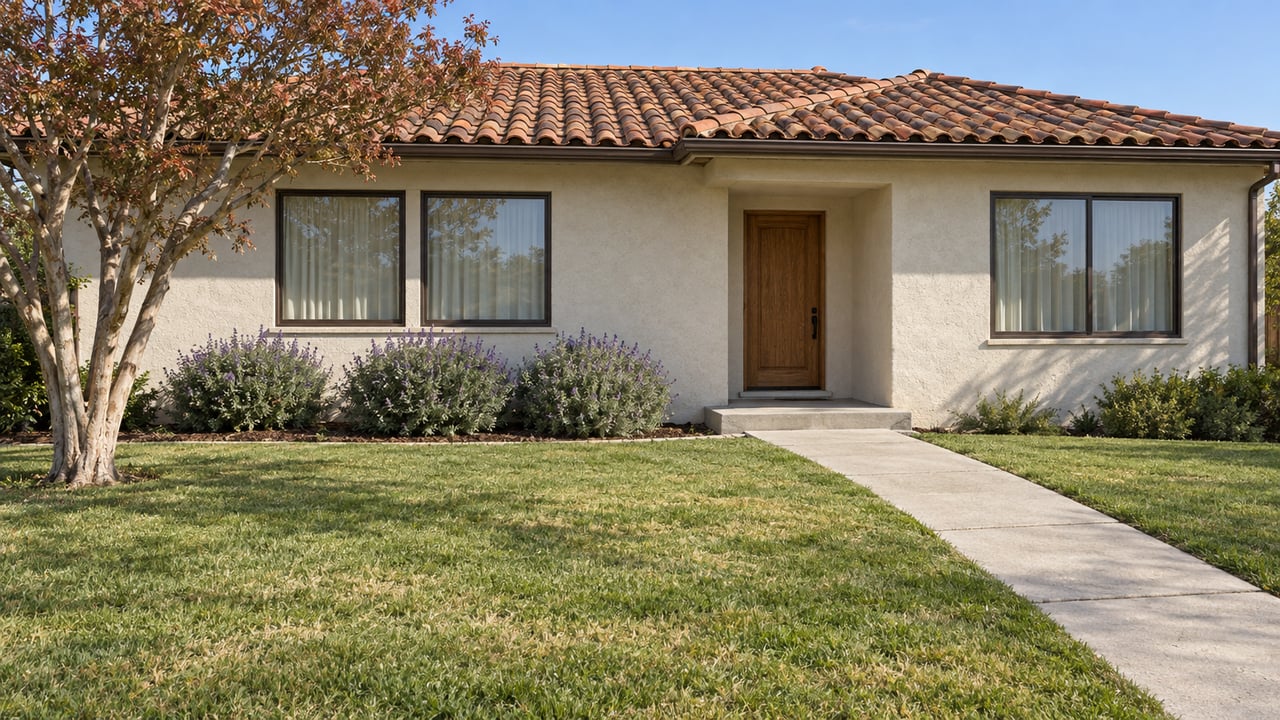
Two San Bernardino County listings can carry nearly the same price and still cost a buyer completely different amounts every month. That gap rarely comes from the mortgage. It comes from a second tax bill that shows up on the property tax statement, not the purchase contract, and it is largest in exactly the part of the county that markets itself as the affordable alternative to Los Angeles and Orange County.
Ontario Ranch, the 13-square-mile master-planned district in the southern part of the city of Ontario, is where that gap shows up most clearly. The community is still filling in a 47,000-home buildout the city expects to take 20 years or more, and nearly every new tract inside it comes with a Community Facilities District, the formal name for what most buyers know as Mello-Roos.
The Two Numbers That Describe the Same County
San Bernardino County's median sale price sounds like a single fact, but two of the most-cited sources for it do not agree, because they are not measuring the same thing. One widely cited figure puts the county median at $548,000 for the three months ending June 2026, covering all home types and reflecting closed sales. The California Association of Realtors' Q1 2026 Housing Affordability Index reports $495,000 for existing detached homes as of May 2026, adjusted for inflation. Neither number is wrong. They describe different slices of the same market, and a buyer who anchors on one while shopping in the other is already comparing apples to a number that was never meant to describe an Ontario Ranch new build.
The more useful split is not between reporting methodologies but between submarkets. CRMLS data from the first quarter of 2026 puts older resale neighborhoods in San Bernardino city, Rialto, and Colton in the $380,000 to $460,000 range, while new-construction communities built by national builders in the Inland Empire's growth corridors, Ontario Ranch included, cluster higher. Ontario Ranch's own current listing data shows new homes carrying a median list price around $729,000 as of this month. On price alone, that looks like the cost of newer square footage and a commute-friendly location near Interstate 15. It is not the whole cost.
What the CFD Stack Actually Adds
Every new residential project inside Ontario Ranch is required to form a CFD, according to the city's own tax administration reports, and most form more than one: one district to fund infrastructure like roads, sewer lines, and parks, and a separate district to fund ongoing services like police, fire, and street lighting. Those special taxes are not subject to Proposition 13's 1% cap or its 2% annual increase limit, because they are not property tax. They are a separate assessment that rides alongside it.
The combined effect on Ontario Ranch is a total effective tax rate of roughly 1.9% to 2.2% of a home's value, base property tax plus CFD assessments included. In older San Bernardino County neighborhoods that predate the common use of CFDs, the effective rate runs 1.1% to 1.25%. Rancho Cucamonga's newer tracts north of Foothill Boulevard, in areas like Etiwanda and near Day Creek, land in between at 1.5% to 1.8%, while established sections of Rancho Cucamonga near Haven Avenue and Terra Vista carry little to no CFD burden at all.
| Area | Effective tax rate | CFD status |
|---|---|---|
| Older San Bernardino County resale (San Bernardino city, Rialto, Colton, established Rancho Cucamonga) | 1.1% to 1.25% | Little to no CFD |
| Rancho Cucamonga newer tracts (Etiwanda, Day Creek) | 1.5% to 1.8% | CFD present |
| Ontario Ranch new construction | 1.9% to 2.2% | Multiple stacked CFDs |
On a $700,000 purchase, the difference between 1.2% and 2.1% works out to roughly $6,300 a year, or about $525 a month, before any mortgage payment is calculated.
The Purchasing Power a Single Assessment Erases
Mello-Roos does not show up as a lump sum. It shows up as an annual special tax line on the property tax bill, typically running $2,000 to $6,000 a year in Inland Empire CFDs, which works out to $170 to $500 a month layered on top of the mortgage payment. Fannie Mae's Selling Guide includes special assessments in the monthly housing expense used to calculate debt-to-income, alongside mortgage payments, HOA dues, and real estate taxes.
That matters at the point of qualification, not just at the point of budgeting. A $4,000 annual assessment effectively reduces a buyer's purchasing power by $50,000 to $60,000, because the lender is sizing the loan against total monthly obligation, not sale price. Two buyers with identical income and identical down payments can qualify for meaningfully different purchase prices depending on whether the home they are chasing sits inside a CFD.
The sticker price on an Ontario Ranch home and the sticker price on a comparable resale home in Rialto or Colton are not directly comparable numbers, even when they land close together. The Ontario Ranch number needs a second line added to it before it means the same thing.
Not Every Ontario Ranch Address Carries the Same Bill
Ontario Ranch is not one neighborhood with one builder and one tax structure. It is an umbrella district covering multiple approved projects, including Grand Park, Rich Haven, Parkside, Esperanza, West Haven, Edenglen, Countryside, and Armstrong Ranch. Landsea Homes alone has sold out communities called Rohe, Alto, and ShadeTree inside Ontario Ranch and is currently adding 144 townhomes to the Eave community and 95 homes in the new Dusa development, each phase carrying tax terms set when that particular CFD was formed.
Two homes with an Ontario Ranch address, built five years apart in different phases, can carry noticeably different special tax bills even at similar price points. The city's CFD tax administration reports break this out by district number, and a buyer comparing homes inside Ontario Ranch needs the specific CFD figure for that tract, not a district-wide average.
The Bill Shrinks, But Only on the City's Schedule
CFD bonds are typically issued for terms of 25 to 40 years from the district's formation date. A district with five years left on its bond term is a very different holding than one with thirty years remaining, even if the current annual assessment looks identical on paper.
That resale math cuts both ways. A newer CFD with decades left to run is a cost a future buyer will factor into their own offer, the same way today's buyer factors it into the offer they write now.
Running the Comparison Buyers Actually Need
The comparison that actually matters is not Ontario Ranch's list price against the county median. It is the fully loaded monthly number, mortgage, base property tax, CFD assessment, and any HOA dues, run against the same fully loaded number for a resale home in San Bernardino city, Rialto, Colton, or an established section of Rancho Cucamonga where no CFD applies.
A home never sells on price alone. It sells on what the buyer's mortgage lender says they can carry every month, and that number reads differently once the CFD line is on it.
The CFD special tax is not a one-time closing cost but a recurring obligation that shows up on the tax bill. Any buyer comparing an Ontario Ranch new build to an older resale home elsewhere in the county should ask for the CFD disclosure and the specific district's current levy before writing an offer, not after.
A Few Questions Buyers Ask
Does Mello-Roos ever show up separately from the mortgage payment? Yes. It appears as a special tax line on the annual property tax bill, not folded into the loan itself, though lenders include it when calculating debt-to-income for qualification purposes.
Do older San Bernardino County neighborhoods ever have Mello-Roos too? It is possible but far less common. CFDs became standard practice for financing new infrastructure after the passage of Proposition 13, so neighborhoods built before that shift, or funded through other means, typically carry little to no CFD assessment.
If you are weighing an Ontario Ranch purchase against a resale home elsewhere in San Bernardino County, The Vasquez Group can run the fully loaded monthly comparison, CFD levy included, before you write an offer. If you are selling in either market and want to know what your equity actually looks like once that comparison is made, get your free home valuation.
This article is general information, not legal, tax or financial advice. Consult a qualified professional about your situation.